Beschreibung
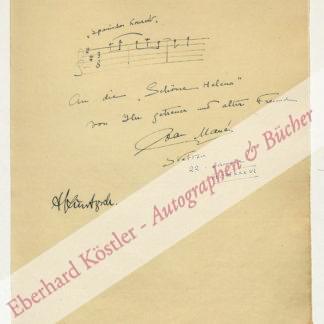
Viertaktiges Hauptmotiv aus seiner Oper „Salome“. – Das Blatt dokumentiert einen der großartigsten Momente der Europäischen Musikgeschichte. Alex Ross hat diesen Moment als Auftakt seiner Musikgeschichte des 20. Jahrhunderts gewählt, das mit dem Kapitel „The golden age“ so anhebt: „When Richard Strauss conducted his opera ‚Salome‘ on May 16, 1906, in the provincial Austrian city of Graz, several leading figures in European music gathered to witness the event. The première of Salome had taken place five months before, in Dresden, and word had got out that Strauss had created something beyond the pale – an ultra-dissonant Biblical spectacle, based on a play by an Irish degenerate whose name was not mentioned in polite company; a work so frightful in its depiction of adolescent lust that imperial censors had banned it from the Court Opera in Vienna. – Giacomo Puccini […] made a trip north to hear what ‚terribly cacophonous thing‘ his German rival had concocted. Gustav Mahler, the director of the Vienna opera, attended, with his wife, the beautiful and controversial Alma. The bold young composer Arnold Schoenberg arrived from Vienna with his brother-in-law, Alexander von Zemlinsky, and no fewer than six of his pupils. One of them, Alban Berg, traveled with an older friend […] The widow of Johann Strauss II, composer of ‚On the Beautiful Blue Danube‘ (and no relation to the composer of Salome), represented old Vienna. Ordinary music-enthusiasts filled out the crowd -‚young people from Vienna, with only the vocal score as hand luggage‘, Strauss noted […] There was even a fictional character present – Adrian Leverkühn, the hero of Thomas Mann’s ‚Doctor Faustus‘ […] Strauss and Mahler, the titans of Austro-German music, spent the day in the hills above the city […] Mahler, for his part, was deeply impressed by his colleague’s music, and especially by ‚Salome‘. Strauss had played and sung the score for him the previous year […] Salome promised to be one of the highlights of Mahler’s Vienna tenure, but the censors balked at accepting an opera in which Biblical characters are made to perform unspeakable acts […] So Salome came to Graz […] As dusk fell, Mahler and Strauss appeared at the opera house. They had rushed back to town in their chauffeur-driven car. The crowd milling around in the lobby had an air of nervous electricity. The orchestra played a fanfare when Strauss walked up to the podium, and the audience applauded stormily. Then a deathly silence descended, the clarinet played a softly slithering scale, and the curtain went up.“